
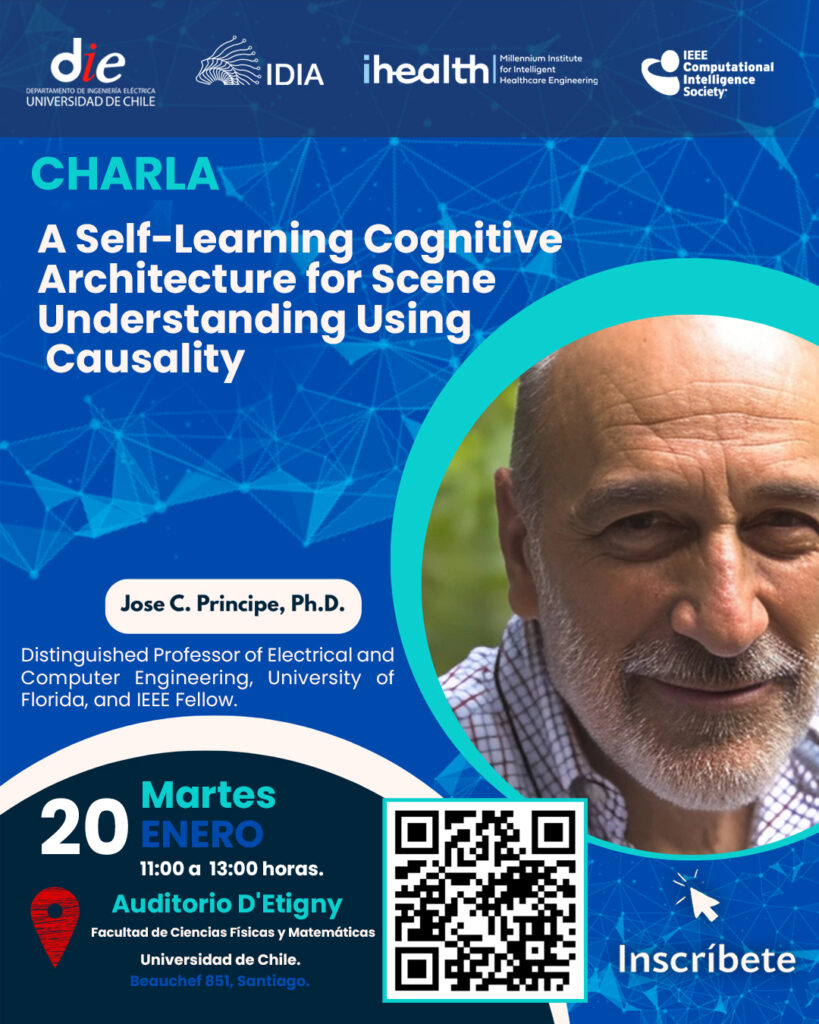
El Departamento de Ingeniería Civil Eléctrica (DIE) de la Universidad de Chile, en colaboración con la Iniciativa de Datos e Inteligencia Artificial (IDIA); el iHealth del Millennium Institute for Intelligent Healthcare Engineering y el IEEE Computational Intelligence Society, invita a la comunidad académica y pública a la charla magistral del distinguido profesor Jose C. Principe, distinguished professor of Electrical and Computer_Engineering,_University_of Florida, and IEEE Fellow.
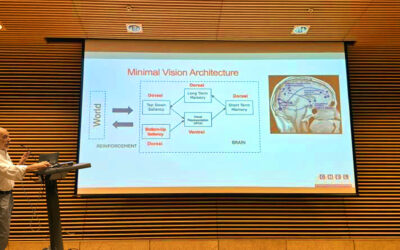
Bajo el título “A Self-Learning Cognitive Architecture for Scene Understanding Using Causality”, el expositor presentará avances pioneros en arquitecturas cognitivas autoaprendientes que imitan el sistema visual animal. Esta propuesta permite reconocer objetos en videos sin necesidad de etiquetas supervisadas, reduciendo drásticamente el ancho de banda computacional requerido.
Jose C. Principe es Distinguished Professor de Ingeniería Eléctrica, Computacional y Biomédica en la Universidad de Florida, fundador y director del Computational NeuroEngineering Laboratory (CNEL). Autor de más de 1.000 publicaciones, con un H-index de 104, ha dirigido 110 tesis doctorales y recibido el prestigioso IEEE Neural Network Pioneer Award en 2012. Es autor de libros clave en el campo, como Information Theoretic Learning y Kernel Adaptive Filtering.
La actividad -en inglés- se realizará el martes 20 de enero de 2026, entre las 11:00 y 13:00 horas, en el Auditorio Enrique D’Etigny de la Facultad de Ciencias Físicas y Matemáticas (FCFM) de la Universidad de Chile (Beauchef 851, Santiago).
Entrada liberada con inscripción previa a través del código QR disponible en la convocatoria o pueden ingresar AQUÍ y completar el formulario de inscripción -son cupos limitados-.
Una oportunidad imperdible para explorar los fronteras de la inteligencia artificial biológicamente inspirada.
¡Inscríbete y no te la pierdas!
Abstract:
This talk describes our efforts to abstract from the animal visual system the computational principles to recognize objects in video without using labels and decreasing the computational bandwidth required. We develop a hierarchical, distributed architecture of dynamical systems that self-organizes and mimics the foveal vision in humans using an empirical Bayes criterion. The system learns from reinforcement with the world, and uses causality to identify objects of interest in the environment. When trained in video games it learning speed is much faster when compared with the tradition Deep Reinforcement Learning algorithms.
Jose C. Principe (M’83-SM’90-F’00) is a Distinguished Professor of Electrical and Computer Engineering and Biomedical Engineering at the University of Florida where he teaches advanced signal processing, machine learning and artificial neural networks (ANNs) modeling. He is the Eckis Endowed Professor and the Founder and Director of the University of Florida Computational NeuroEngineering Laboratory (CNEL) www.cnel.ufl.edu. His primary area of interest is processing of time varying signals with adaptive neural models. The CNEL Lab has been studying signal and pattern recognition principles based on information theoretic criteria (entropy and mutual information).
Dr. Principe is an IEEE Fellow and received the prestigious IEEE Neural Network Pioneer Award in 2012. He was the past Chair of the Technical Committee on Neural Networks of the IEEE Signal Processing Society, Past-President of the International Neural Network Society, and Past-Editor in Chief of the IEEE Transactions on Biomedical Engineering. Dr. Principe has more than 1000 publications, and an H-index of 104 (Google Scholar). He directed 110 Ph.D. dissertations and 66 Master theses. He wrote in 2000 an interactive electronic book entitled “Neural and Adaptive Systems” published by John Wiley and Sons and more recently co-authored several books on “Brain Machine Interface Engineering” Morgan and Claypool, “Information Theoretic Learning”, Springer, and “Kernel Adaptive Filtering”, Wiley.
Actividad con inscripción previa, a través del código QR disponible en la convocatoria o pueden ingresar AQUÍ y completar el formulario de inscripción -son cupos limitados-.
07-01-2026